



Binita, 16, Laxman, 13, and Ramita, 14, from the Nepali Newsroom interview one of the leading activists in the protests in Nepall
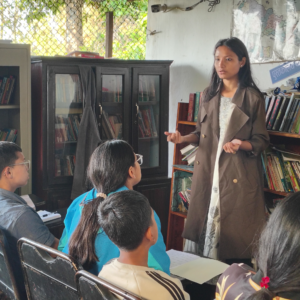
Rakshya Bam talking to students from the Nepali Newsroom.
12 June 2026
The experience of a Gen Z Leader: An interview with Rakshya Bam
Rakshya Bam is one of the young leaders who led the Gen Z uprising in Kathmandu last September. She had several opportunities to join politics or enter parliament, but chose to stay outside and question the government.
The Gen Z protests took place on 8 and 9 September 2025, killing 77 people and injuring hundreds more. They resulted in the overthrow of the government, led by KP Sharma Oli, and the formation of a new interim government. Balen Shah became the new prime minister after the elections on 5 March.
In an interview with Harbingers’, the 26-year-old stated that the Gen Z protests began peacefully but turned violent due to the government’s excessive use of force.
Harbingers’ Weekly Brief
Subscribe to the Harbingers’ Weekly Brief, a newsletter written by the editorial board of Harbingers’ Magazine, the world’s youngest newsroom, delivered to your inbox every Monday morning.
![author_bio]()
![author_bio]()
![author_bio]()
![author_bio]()


“Since then, the Gen Z uprising has been a rollercoaster for me,” Bam told us. Following the protests, the youths, including Bam, had to negotiate with the Nepal Army to restore Nepal’s government.
She said, “I stayed awake all night on 8 September, waiting for a new day. On 9 September, Prime Minister Oli fled by helicopter. After Oli’s reign, it felt like the country belonged to us. We had brought an arrogant regime to its knees. That is the power of the Gen Z movement.”
She explained that her generation were irritated by the behaviour of leaders who had been around forever. The protests were primarily against corruption, a social media ban, and the “nepo baby” trend.
View this post on Instagram
“They never understood the voice on the street. The global ‘nepo baby’ trend reached Nepal. It demonstrated the contrast between the lifestyles of politicians and their families and ordinary people,” she told us.
She gave numerous examples of the previous Oli government’s silly responses to youths and their demands: “He told the public that Lord Ram [the Hindu god] was born in Nepal to make them happy, when the truth was that Ram was born in India.”
She also provided another example in which Oli consistently ignored public demands, even during the Covid-19 pandemic. Nepal received vaccination doses from other countries, but proper distribution was hindered by corruption even during a critical period.
The Gen Z protests resulted in significant political change in Nepal. The government had to reverse the social media ban, and some leaders resigned, demonstrating that people’s voices matter.
"We should continue to speak out. We will question if something goes wrong. We will act as a watchdog for this government,” said Bam.
The Gen Z Movement is primarily credited with changing Nepal’s leadership. In this year’s elections, Balen Shah’s RSP emerged as the largest party, while traditional parties were marginalised with a small number of votes.
“It has inspired many countries and their youths to speak out against corruption and wrongdoings,” Bam said. “The protests also inspired young people to take part in politics in Nepal. Now, we have young lawmakers from different parties.”
Most importantly, according to Bam, it provided new hope to Nepalis and demonstrated that real change is possible when young people band together.


Edited by:

© 2026 The Oxford School for the Future

