Harbingers’ Magazine is a weekly online current affairs magazine written and edited by teenagers worldwide.
harbinger | noun
har·bin·ger | \ˈhär-bən-jər\
1. one that initiates a major change: a person or thing that originates or helps open up a new activity, method, or technology; pioneer.
2. something that foreshadows a future event : something that gives an anticipatory sign of what is to come.
We and our partners may store and access personal data such as cookies, device identifiers or other similar technologies on your device and process such data to personalise content and ads, provide social media features and analyse our traffic.
Spain is still in shock following two deadly train crashes that have ignited concerns over rail safety and infrastructure in the country.
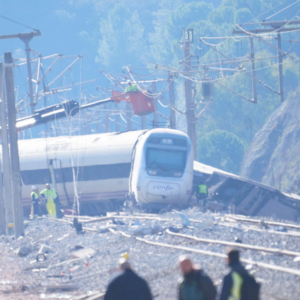
The first accidentoccurred at 7.45pm on Sunday 18 January, when two high-speed trains collided in southern Spain at Adamuz near Córdoba, killing at least 45 people and injuring hundreds.
A Madrid-bound train run by private company Iryo derailed and crossed on to the opposite tracks, striking a south-bound train heading to Huelva, run by state rail company Renfe. Most of those killed and injured were in the front carriages of the Renfe train. The incident is Spain’s deadliest rail crash in more than a decade.
As a result of the crash, the major high-speed rail line between Madrid and Andalucía was suspended for a month, reopening on 17 February.
According to Spain’s rail investigation commission, the CIAF, a gap of almost 40cm was found at a welded joint in the track. The commission reported that the Iryo train’s front carriages – which did not derail – had “notches” in their wheels consistent with striking a broken section of rail. Similar damage was also identified on three trains that went over the track earlier the same evening.
“These notches in the wheels and the deformation observed in the track are compatible with the fact that the track was cracked,” CIAF’s preliminary report said.
It is suspected that an alleged aluminothermic weld (a common method for joining rails) or weakness in the welded area caused the derailment. The new rail was installed in mid‑2025 and joined to an older rail, which isn’t unusual but is under review.
For now, the contractors under investigation are engineering and construction company Azvi, train operators Iryo and Renfe and the rail supplier ArcelorMittal.
Laboratory tests are also needed for metallographic analysis of the rail samples as well as a review of the black box data, and further calculations to determine whether the fracture came from a bad weld, material defect or fatigue from use.
Harbingers’ Weekly Brief
Subscribe to the Harbingers’ Weekly Brief, a newsletter written by the editorial board of Harbingers’ Magazine, the world’s youngest newsroom, delivered to your inbox every Monday morning.
See you on Monday!
Ooops - please try again.
Another deadly crash
The second accident occurred just two days later, on Tuesday 20 January. A trainee train driver was killed and at least 41 passengers were injured after a commuter train collided with a retaining wall that had fallen onto the tracks between Gelida and Sant Sadurní, near Barcelona.
Rail officials believe the wall collapsed at approximately 9pm, striking the driver’s cab first before causing significant damage to the train’s first carriage.
The crash took place as heavy storms battered north-eastern Spain, with coastal areas on high alert due to severe weather conditions.
Many residents are worried that the two incidents are not isolated events and have grown hesitant to use trains. That anxiety has intensified after the second crash.
It seems that there could be a pattern of negligence and under-maintenance in the causes for both of these fatal train crashes.
Under mounting political and public pressure, Spanish transport minister Óscar Puente claimed that he still possessed the quality control certificate for the batch of rails installed on the track where the first crash (18 January) occurred.
This raises the question, why didn’t inspections detect any problems? Both acoustic and ultrasonic tests were done on the track in autumn 2025, and investigators will examine whether those missed a developing crack.
Whether the cause was human error, insufficient maintenance or a structural defect, public confidence is unlikely to recover until a transparent investigation is conducted and concrete solutions are implemented. Until then, many Spanish citizens are refraining from using the country’s rail network.
Born in 2007 in Kyiv, Sofiia studies in Benitachell, Spain. She is interested in business studies, particularly marketing and plans to study at Geneva Business School in Barcelona. For Harbingers’ Magazine, she writes about gaming and books.
In her free time, Sofiia enjoys video games, reads dystopian fiction, and spends time with her dog. She also was a part of a debating team in Ukraine and won the best speaker award at the Dnipro Open Debating Tournament in 2022.
Sofiia speaks Ukrainian, English, Russian, French, and a bit of Spanish.
🌍 Join the World's Youngest Newsroom—Create a Free Account
Sign up to save your favourite articles, get personalised recommendations, and stay informed about stories that Gen Z worldwide actually care about. Plus, subscribe to our newsletter for the latest stories delivered straight to your inbox. 📲
We use cookies to ensure that we give you the best experience on our website. If you continue to use this site we will assume that you are happy with it.