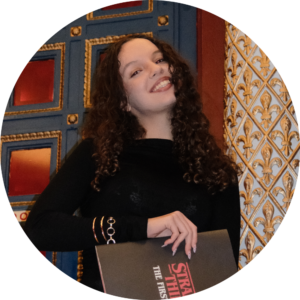


Maja and Aleksandra, both 16, interview one of the Netflix show’s creators


Maciej Buchwald, the director of Netflix’s 1670
5 January 2026
‘You can’t just dress up and pretend to be young people,’ says 1670 director Maciej Buchwald
This show took Netflix by surprise – not much indicated that 1670, a historical mockumentary set in Poland in the 17th century, with humour deeply rooted in Polish history, traditions and politics, would make it into the top ten in over twenty countries, including Austria, Jamaica and Canada.
Maciej Buchwald, who with Kordian Kądziela co-directs the show written by Jakub Różyłło, was born in 1986 in Warsaw, Poland. Maciej graduated from the National Film School in Łódź and over a decade built a career as a director, actor and improviser.
Harbingers’ Film & Book Club writers Maja Dobrosielska and Aleksandra Tomaszewska spoke to him about success, how difficult it is to translate some jokes – and what working with Netflix is like.
The following excerpt from the recorded interview was edited for clarity and consistency.
Aleksandra Tomaszewska (AT): Did you expect 1670 to reach an international audience?
Maciej Buchwald: Last month I went into a bookshop in Athens and there was this man who had been running it for 30 years. I was wearing this cap and he said, “I saw this series, this Polish series.” He said that he didn’t understand all the nuances of our history, but that he laughed a lot. So it means that it worked for him too.
Maja Dobrosielska (MD): Were there any scenes that you decided were too controversial to include?
There was one scene that Netflix – because they also have a legal department – started to worry about. It was a scene inspired by the Pietà.
In my head, it was supposed to be a symbol of a mother suffering over the fate of her child, and that’s why I used the image of the Pietà, because in the Baroque period religious symbolism was common. So if you wanted to convey something, you used religious symbolism and it wasn’t controversial in any way.
But Netflix – their legal department, to be specific – got scared. They were afraid that someone might think that we were making fun of religion, because it is an image of God.
MD: Are there any scenes that made it in and you think are borderline?
Well, there are a few in the second season. We joke that Kuba Różyłło is the most daring when it comes to sexual jokes in the series. I am the most prudish, because I believe that they don’t quite fit in, and Kordian Kądziela is somewhere in the middle.
In the second season, Kordian directed the Kupala Night episode, which is surely the most controversial of all. There’s this scene where Stanisław and Jakub are talking about Kupala Night, and you can see Stanisław’s shadow. It resembles a certain male organ. And then, when Jakub appears, the shadow lands on his face.
When I saw it, I said: “Guys…” But they think it’s great.
AT: And was it difficult for you to combine contemporary jokes with the fact that the entire series takes place in the 17th century?
I would say that it’s not difficult, because the whole comedy engine is based on that in this series. I introduced one rule: as psychological truth is necessary for the characters, the viewer must also believe in the world.
When you watch Dune, you believe that there is spice and that there are worms, because it’s so well done. You watch The Lord of the Rings and you believe that there are orcs, because they’re so well done. If they were poorly made, the rest of it wouldn’t work, because the world wouldn’t feel real.
What is difficult, is our convention. The characters sometimes talk straight to the camera, say things that are contemporary, or suddenly there appears a wooden smartphone. In order to believe it all, you need to have a foundation.
You need to have a real manor house, real mud, real horses, so that your brain would keep telling you: “Aha, OK, we’re in the 17th century.”
MD: Did you have any problems with historical accuracy, for example, in terms of public reception?
An example would be the storyline of Zofia’s romance with Rozalia. Some would say: “typical Netflix, every show must have a homoerotic storyline”, but I heard a historian who said that a figure like Zofia – a very closed, devout woman in the 17th century – was often someone who was hiding their homosexuality, or repressing it and escaping into strong religiosity.

MD: And how do you make new seasons now? Do you keep some of the things that you know people liked, or is it still very much your own creation from your point of view, and you just do it your own way?
In my opinion, you have just said something very important.
If the first season was successful because we did it ourselves, it was a risk and we thought, “OK, maybe ten people will like it”, but it turned out that thousands liked it. After that, the most idiotic idea now would be to say: “Let’s try to repeat what worked.” Because then we stop being authentic. If we want to continue being authentic, we have to keep following our own path. If we tried to repeat our success, it would be no different from trying to copy someone else.
Copying yourself is the same as copying someone else. For me, especially with success, it’s even more important to discipline yourself all the time – not to rest on your laurels, not to cash in – because that’s a sure way to make it stop being good.
AT: Did you think a lot about how to create these jokes so that they would appeal to the widest possible age group, or did you just use your own sense of humour?
I think that if we thought we had to give something to Gen Z, we’d fail. Someone may say there are so many millennial jokes in the series, but we are millennials.
Kuba was born in 1987, I was born in 1986, Kordian was also born in 1987, the producers were born in 1985 and 1987. It’s hard for us to have the sense of humour of 20-year-olds or 70-year-olds.
I think by being honest in that sense of humour, and also allowing for a wide range of humour – from slapstick to more edgy jokes, less edgy jokes, political, verbal, intellectual, post-cultural, situational – everyone can find something for themselves.
AT: I have the impression that there are currently a lot of productions that are targeted at Gen Z, but then the feedback is very poor because they lack authenticity. Many make such a stupid mistake – Gen Z is a very ironic, very savvy and very critical generation, so they can sense when something is fake.
You can’t just dress up and pretend to be young people. We do what we enjoy, and then it’s a matter of taste, not a matter of age. Someone just likes this type of humour; someone doesn’t. But a silly, medium-quality short video recorded on a phone will work better than if you take an expensive camera and try to pretend it was a phone.