



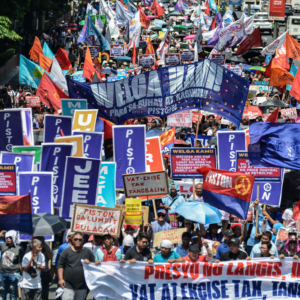
17-year-old Samantha explains how Filipino transport drivers and consumers have been impacted by war in the Middle East
Philippines president Ferdinand Marcos Jr. declared a state of national energy emergency on 24 March, citing unmanageable rising fuel prices amid the escalating unrest in the Middle East following US and Israel’s attacks on Iran.
The disruption followed the 2 March closure of the Strait of Hormuz – through which roughly 20% of global oil trade passes – by Iran’s Islamic Revolutionary Guard Corps.
Rising oil prices are a major concern for Filipino consumers, increasing the costs of food, transportation and other necessities. Neighbouring countries have managed to cushion similar shocks, which raises troubling questions. Is this the result of weak policies by the Filipino government? Or are government officials purely tied to commit corrupt anomalies than to serve its people?
Harbingers’ Weekly Brief
Subscribe to the Harbingers’ Weekly Brief, a newsletter written by the editorial board of Harbingers’ Magazine, the world’s youngest newsroom, delivered to your inbox every Monday morning.
![slide image]()
![author_bio]()
![author_bio]()


Rising fuel and food prices
The Philippines lacks domestic oil production capabilities and is heavily reliant on imports. The closure of the Strait of Hormuz threatened potential fuel shortages by the third quarter of 2026, putting pressure on the authorities to act fast.
As of 31 March, diesel costs surged from 109.5 Philippine pesos ($1.83) per litre to PHP144.8 ($2.41).
The increase in oil prices also raises the cost of fertiliser production and therefore the cost of food, particularly for rice. In New Las Piñas City Public Market, imported white rice costs PHP 68 per kilo. Rice is a major staple in the Philippines, so this puts local consumers in a vulnerable position.
“It’s burdensome… this time is really tough. Before, we could buy rice for around 60 pesos, but now it has gone up to 65 pesos per kilo,” an anonymous buyer told Harbingers’ Magazine.
Also, the Philippine peso has dropped to a record low, depreciating at PHP 60.69 against the US dollar. This has decreased the country’s import capabilities.
What is the Filipino government doing?
The executive order signed by President Marcos has set out a Unified Package for Livelihoods, Industry, Food, and Transport (UPLIFT) framework, which aims to stabilise the energy supply, support the transport and agriculture industries and other businesses, and safeguard the country’s population.
In an attempt to keep fuel flowing across the country, on 1 April the Department of Energy (DOE) issued guidelines to monitor fuel prices across the country. The national police and other civil organisations were deployed to enact this legislation.
The Department of Labor and Employment (DOLE) has also earmarked an initial PHP 1.2bn ($20m) to assist vulnerable workers.
View this post on Instagram
Philippines vs neighbouring countries
Oil prices in the Philippines have soared due to several factors, such as weak domestic oil refining infrastructure. Petron Corporation operates the country’s only remaining oil refinery, the Bataan Refinery, after the Pilipinas Shell Petroleum Corporation permanently closed its operations during the Covid-19 pandemic.
More importantly, the oil industry has a significant lack of regulation. It currently operates under the 1988 “Oil Deregulation Law”, which authorises commercial oil retailers to set their own prices, restricting the national government’s authority to intervene over fuel costs.

“This is an unregulated industry… The government does not dictate the price. So it is competition among the companies that determines the movement of prices,” energy secretary Sharon Garin said.
The crisis also exposes the lack of energy stockpiles in the Philippines, mainly due to policy uncertainties that neighbouring countries have already overcome. For instance, Indonesia, Southeast Asia’s major natural gas supplier, regulates the downstream sector of the oil and gas industry – that is, the system under which crude oil is produced and refined. This does not happen in the Philippines.
Indonesia is also promoting renewable energy, making the country less vulnerable to energy shocks. Although Japan imports93% of its oil from the Persian Gulf, it has managed to stockpile millions of barrels to offset the effects of the conflict.
Impact on commuters and transport workers
Along the busy roads of Zapote, Las Piñas, jeepney drivers continue with their routes as usual. As his vehicle lurched through traffic, one driver remarked, “Well, with fuel prices going up, we just have to push through and push through.” This reflects the Filipino value of resilience in the face of crisis.
Transport workers took to the streets in a two-day strike in late March to press the government for stronger measures as fuel prices skyrocketed. They want fares to increase, because the soaring fuel prices leave little to spare for their daily necessities.
After all, the fight of daily commuters is the fight of transport drivers, and neither should be sacrificed to the comfort of either party.
Harbingers’ Magazine talked to Jose Dela Cruz Jr., a security guard in the Zapote Arcade about his daily transport costs.
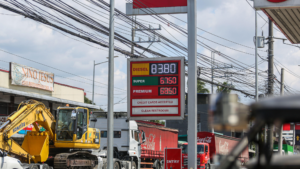
“It’s really going up – before, my fare from SM Bacoor to Zapote was 13 pesos, now it’s already 20. The cost of daily needs continue to rise, but the wages of guards do not. It feels as if our government isn’t paying any attention to us,” he said.
In difficult times like this, workers are calling on the government to implement concrete policies that would increase the minimum wage and provide meaningful relief.
Recently, President Marcos Jr. suspended the fare hikes, believing that commuters need not be burdened further with the Middle East crisis.
The ongoing conflict in the Middle East has also sparked renewed discussions on shifting from fossil fuels to renewable energy. Energy secretary Sharon Garin said that the DOE is working closely with developers to fast-track the completion of 1,471 megawatts of renewable energy powered projects.

Edited by:

© 2026 The Oxford School for the Future

