



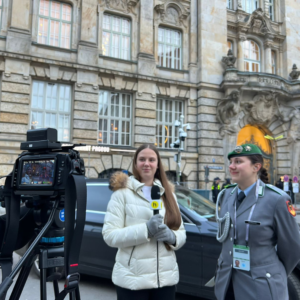
16-year-old Irma reports from last weekend’s Munich Security Conference
The streets outside the Bayerischer Hof were cold and grey, typical of Munich in February. The area around the hotel was blocked off by security checks, with swarms of police and journalists waiting near the entrance.
Black luxury cars arrived one after the other, delegates stepped out and walked through the doors that were then shut from the real world beyond. The atmosphere felt surreal, knowing the world’s most important officials were inside.
The 62nd Munich Security Conference (MSC) took place on 13–15 February, at a moment that feels critical for the stability of the world. More than 1,000 participants from over 115 countries attended, including around 60 heads of state and government.
The conference invoked feelings of curiosity – I wanted to know what was being privately said by individuals we trust to lead us. A powerful atmosphere settled over the city, simply knowing that you were at the centre of where diplomacy takes shape.
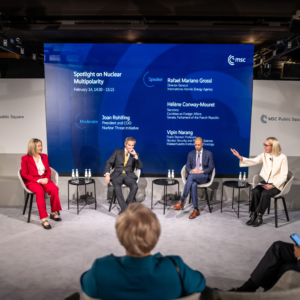
This year’s MSC unfolded under the shadow of the report published by the European Nuclear Study Group, entitled Mind the Deterrence Gap,which warned that the global order we have relied on for decades is now under serious threat.
The message from the report was blunt: the era of European complacency is over. “Europeans can no longer outsource their thinking about nuclear deterrence to the United States,” the report states. “The era in which Europe could afford strategic complacency has ended.”
It outlined several possible pathways for Europe’s nuclear future, including strengthening the roles of Britain and France, and reconsidering how Europe protects itself in a world where American leadership can no longer be taken for granted.
This year in Munich, the growing divide within the West itself was a theme that stood out above all the others.
The rise of ‘West vs West’
For decades, the Munich Security Conference symbolised transatlantic unity. This changed at last year’s conference with US vice-president’s JD Vance’s speech in which he criticised Europe for suppressing speech and mishandling migration.
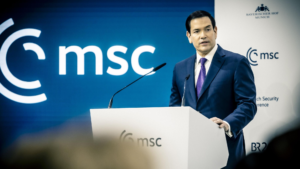
This year, US secretary of state Marco Rubio attempted to reassure European allies, stating that “the fate of Europe will never be irrelevant to our own,” and that it remains the US’s preference to work together.
However, his speech revealed a more transactional American approach to foreign policy. Rubio argued that after the Cold War, the West fell into what he described as a “dangerous delusion”, the belief that history had ended and that liberal democracy and globalisation would naturally spread across the world.
Harbingers’ Weekly Brief
Subscribe to the Harbingers’ Weekly Brief, a newsletter written by the editorial board of Harbingers’ Magazine, the world’s youngest newsroom, delivered to your inbox every Monday morning.
![slide image]()
![slide image]()
![author_bio]()
![author_bio]()


According to Rubio, this mindset weakened the West. He criticised deindustrialisation, dependence on rival countries for supply chains, reduced defence readiness, and energy policies he blamed on ideology. He described deindustrialisation as “a conscious policy choice” that “cost us dearly”.
Central to his speech was the idea of sovereignty. National security, he argued, is about protecting “a people… a nation… a way of life.” He emphasised shared identity, stating: “We are part of one civilisation, Western civilisation.”
But this language caused discomfort among non-Western representatives, reinforcing concerns that global cooperation is increasingly being replaced by civilisational politics.
The tension between Europe and the United States was evident. The Munich Security Report 2026 – entitled Under Destruction, which was published prior to the conference – accuses US President Donald Trump of taking “an axe to existing rules and institutions” and warns that Washington may be contributing to a post-American world order.
Europe is beginning to realise that dependence on the US has limits.
Ukraine at the centre
Ukraine remained the emotional and political core of the conference.
President Volodymyr Zelensky received a standing ovation as he entered, wearing a dark suit instead of his usual military-style clothing. He warned against any peace built on territorial concessions, comparing it to Europe’s failure to prevent World War II.
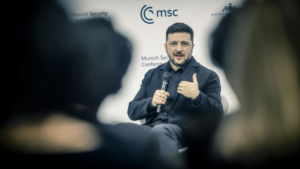
“Our unity is what protects us,” Zelensky said. “Our unity is the best interceptor against Russia’s aggressive plans.”
He stressed that Ukraine needs strong security guarantees before agreeing to any deal and repeated his position that NATO membership remains the best long-term protection, even though it is currently ruled out by the Trump administration.
He stressed that Ukraine needs strong security guarantees before agreeing to any deal and repeated his position that NATO membership remains the best long-term protection, even though it is currently ruled out by the Trump administration.
NATO secretary general Mark Rutte insisted that Russia is not winning the war, despite small territorial gains, and credited the US for continuing to supply weapons, even as Europe pays more of the cost.
Still, uncertainty lingers. During a Q&A session, Rubio admitted: “We don’t know the Russians are serious about ending the war.” The key issues, he said, have been narrowed, but they are now the hardest to solve.
Are young voices being heard?
While inside the Bayerischer Hof, the presidents and ministers debated the future of the world order, I wanted to understand what role young people play in these discussions.
The conference included programmes aimed at emerging leaders, but several people I spoke to did not know how to react when asked, “Are young voices being heard?” They were left asking themselves if young voices could influence the discourse among leaders.
Albrecht, a 24-year-old MSC staff member, said youth inclusion is often more symbolic than real.
“They always say we hear the young,” she said, “but behind closed doors it’s often still the same voices that rule the world.”
A 16-year-old Munich secondary school student, standing outside the conference and working on a school assignment, was more direct: young people, he argued, are “ignored a lot”, despite making up a large proportion of the population. Without voting power or formal political authority, their influence remains limited.
Even seasoned journalists acknowledge the imbalance. Joakim Klementi, European correspondent for Estonian Public Broadcasting, noted that coverage mostly centres on heads of state and senior ministers, not young citizens. “Is your voice being heard?” he asked me in return. The question lingered long after the interview ended.
Development left behind
While defence and military spending dominated the conference, international development and humanitarian assistance were far less visible in the main debates.
Panels on climate, food security, debt and trade were included, but many felt secondary as European governments shift toward higher defence spending targets.
Rajiv Shah, president of the Rockefeller Foundation, warned that this creates “extraordinary pressure on development”, even though military officials often describe it as a form of “forward defence” that prevents future instability.
View this post on Instagram
Leaders from the Global South stressed that development and security cannot be separated. Senegal’s prime minister pointed to Africa’s debt crisis as a driver of future migration pressures, while the Maldives’ foreign minister argued that climate change, rather than armed conflict, is his country’s most urgent threat.
However, voices from the Global South remained limited overall, highlighting how global security discussions are still largely shaped by Western priorities.
A more transactional world
Across the three days, one broader pattern became clear: the global order is shifting from cooperative to transactional.
There is growing scepticism towards multilateral institutions such as the United Nations. Marco Rubio criticised the UN as ineffective, while China’s foreign minister Wang Yi defended it, arguing that countries have a responsibility to reform institutions, not destroy them.
European leaders such as Germany’s chancellor Friedrich Merz and France’s president Emmanuel Macron called for greater European strategic autonomy, including discussions around a potential European nuclear deterrent. UK prime minister Keir Starmer stressed that Britain’s security and Europe’s security are inseparable and that Europe must be “ready to fight”.
The message from Munich was not that the transatlantic alliance is over, but that it is being renegotiated in real time.
By the final evening, the grey February streets felt calmer and the black cars had disappeared. The doors of the Bayerischer Hof closed once again. They will reopen next February to debate a future that my generation will inherit, whether we are invited to shape it or not.

Edited by:

© 2026 The Oxford School for the Future