logo

Harbingers’ Magazine is a weekly online current affairs magazine written and edited by teenagers worldwide.

harbinger | noun

har·​bin·​ger | \ˈhär-bən-jər\

1. one that initiates a major change: a person or thing that originates or helps open up a new activity, method, or technology; pioneer.

2. something that foreshadows a future event : something that gives an anticipatory sign of what is to come.

cookie_image

We and our partners may store and access personal data such as cookies, device identifiers or other similar technologies on your device and process such data to personalise content and ads, provide social media features and analyse our traffic.

4 September 2026

I stopped using my phone two hours before bed. This is what happened

author_bio
​​Sofia Vorobei in Vergel, Spain

Article link copied.

slide image

Avoiding phone use before bed may help improve sleep quality.

Picture by: Harbingers' Project

I’ve never been particularly good at putting my phone down before bed. Usually, I use it right up until the moment I decide to go to sleep.

I’ll check my messages, reply to a few people, maybe look at something quickly. In fact, I tend to end up spending much longer on my phone than I thought I would.

I normally have trouble falling asleep and tend to wake up at least three times during the night. This means that I often worry about whether I’m going to sleep at all.

This is why I decided to try to stop using my phone two hours before going to sleep for two weeks.

Honestly, I wasn’t expecting a miracle. I was mostly just curious. The whole “no screens before bed” thing is something my mom kept telling me to try. I wanted to see if it actually makes a noticeable difference.
.
There is some science behind the advice. According to sleep experts, screens produce blue light, which suppresses the body’s production of melatonin – a hormone responsible for controlling our sleep patterns. It also affects our circadian rhythm, our body’s internal clock.


View this post on Instagram


A post shared by Harbingers’ Magazine (@hrb.mag)

The content we consume matters too. Scrolling through social media, answering messages or watching videos can keep the brain stimulated when it is supposed to be winding down.

This is why scientists recommend reducing screen time before bed. There’s no set period, but as a rule of thumb doctors recommend 1-2 hours before going to sleep.

Days 1 and 2

The first thing I noticed was how automatic it was to reach for my phone. I’d finish doing something and instantly look for it. Two hours felt much longer than I expected.

There was also this strange feeling that I was supposed to be doing something. I wasn’t waiting for an important message or actually missing anything, but without my phone there was suddenly a lot of empty time I felt I had the obligation to fill.

I also got really bored.

My sleep itself didn’t actually change. When I eventually went to bed, I fell asleep pretty much as usual. This wasn’t unexpected, since I hadn’t expected to become a perfect sleeper after only two nights.

Days 3 and 4

By the third and fourth days, not having my phone started feeling less weird.

My evenings still felt longer, but instead of automatically picking up my phone whenever I had nothing to do, I started doing other things. I talked to my brother, journalled, listened to music. I mostly found small things to occupy myself with, which is something I wasn’t doing frequently before bed.

My sleep still hadn’t changed much. This kind of made me question whether the experiment was actually doing anything. But then I thought that removing a phone might not produce an obvious result for every person, especially after just a few days.

Sleep is affected by many other factors, including stress, routine, light, caffeine and individual sleep patterns. So I thought that might be the reason.

slide image
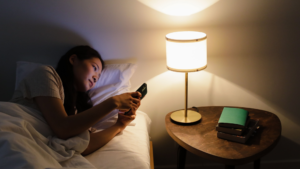
  • Using your phone before bed can keep the mind stimulated when it should be relaxing.

    Picture by: Ron Lach | Pexels

  • Days 5 to 7

    At this point, the experiment started feeling less pointless.

    Because I had relatively little to do in those two hours, I started becoming sleepy more quickly in the evening. So I began going to bed a little earlier, simply because I was bored and tired.

    I used to go to bed at around 1am, but without my phone my bedtime became midnight or sometimes even earlier.

    Falling asleep seemed easier too, although not that much. It wasn’t like I put my phone away and immediately fell asleep. It was more subtle. But I think there was a difference.

    There was one downside, though: sometimes I missed my phone.

    There were nights when I wasn’t particularly tired, but also I didn’t have anything else I wanted to do. Going to bed early just because I was bored felt pointless, so I sometimes wished I could text my friends or my boyfriend for a while.

    That made me realise my phone wasn’t always something I was using because I actually wanted to. Sometimes I was using it because I didn’t know what else to do. This made me reflect on whether young people use their phones that much in order to avoid boredom.

    Days 8 to 10

    By this point, it stopped feeling like an experiment.

    The first few nights felt strange, but now it felt a lot more like a routine. I didn’t have to constantly remind myself that I wasn’t supposed to use my phone.

    Something else changed that was more personal to me: sleep started feeling a bit less intimidating.

    That doesn’t mean every night was easy. I still had occasional rough nights. But I wasn’t constantly thinking about whether I’d fall asleep, and that made bedtime feel less scary.

    Days 11 to 14

    The biggest surprise was how much time I suddenly seemed to have. Two hours is a surprisingly long time when you aren’t on your phone.

    Another unexpected change was how much quieter my thoughts felt at night. Sometimes that was really nice. At other times, the thoughts were as loud as usual and it was annoying. If I had a lot on my mind, there was suddenly nothing distracting me from thinking about it.

    But by the end of the two weeks, I had started looking forward to the quieter part of the evening.

    During the last four days of the experiment, I did wake up less during the night than I usually do. That was the most noticeable change for me, along with feeling less intimidated by the sleep itself.

    Would I keep doing it?

    Probably – but not for two hours.

    Two hours was useful as an experiment, but realistically, I don’t think I need such a strict rule every night. One hour before bed would be enough, I feel.

    Written by:

    author_bio

    ​​Sofia Vorobei

    Culture Section Editor 2026

    Vergel, Spain

    I’m Sofia Vorobei, with a passion for quality cinema. It all started when I was around eight. While watching one of those Nickelodeon sitcoms, I couldn’t stop thinking about how fun it must be for the actors and how I wished I could be part of something like that. Ever since then, I’ve wanted my life to have something to do with it. I’ve wanted to act, create, write, direct…

    In middle school, however, my perception of that changed. I wasn’t eight anymore, and I understood that this path is an uphill battle. It’s demanding, messy, and a bit like a lottery: you either get very lucky and win, or you don’t.

    Still, that realisation didn’t push me away from my dream; it was simply a reality check. I began to understand that passion alone isn’t enough — it takes hard work and making the most of every resource available, while continuing to improve without rushing the process. The industry may be unpredictable, but I believe that if you truly put everything into something, it has a way of standing out.

    I was born in 2009 in Kyiv, Ukraine, and moved to Vergel, Spain, near Valencia, in 2020.

    I joined Harbingers’ Magazine in the summer of 2023 and have since written about the intersections of culture, creativity and society. My work with the magazine led to my appointment as Culture Section Editor in March 2025. 

    I also serve as Afghanistan Newsroom Editor, roles I continue to hold in 2026, helping shape the magazine’s cultural coverage and coordinate reporting within the newsroom.

    I speak Ukrainian, Spanish, English and Russian.

    Edited by:

    author_bio

    Lukas Abromavicius

    Economics Section Editor 2026

    Sevenoaks, United Kingdom

    opinion

    🌍 Join the World's Youngest Newsroom—Create a Free Account

    Sign up to save your favourite articles, get personalised recommendations, and stay informed about stories that Gen Z worldwide actually care about. Plus, subscribe to our newsletter for the latest stories delivered straight to your inbox. 📲

    Login/Register