




16-year-old Anastasia explores the acting techniques that actors use to build authentic and realistic characters
How do actors – on screen or stage – convince audiences that their characters are believable? The audience would not believe in the storyline or the actions of a character if the actors did not play their roles realistically and authentically. A good character is not just down to the script, the actors bring it to life because they feel and express it naturally.
You might think it’s simple, but there is science behind the art of acting. So let’s start exploring deeper.
View this post on Instagram
Facial expressions
There are more than 40 distinct facial muscles that are responsible for creating expressions. There are three different types of facial expressions:
Macro expressions are often seen in regular conversation. The person is not trying to hide anything, just simply expressing their feelings. These typically last half a second to five seconds.
Subtle expressions can be called a mini leakage of the emotions a person is trying to conceal. It is usually limited to one region of the face and is low intensity, indicating only the start or fading of an emotion.
Micro expressions are quite hard to spot as some emotional signals can appear in as little as 1/25th to 1/5th of a second. They flash across the face, appearing sometimes unintentionally, revealing the concealed true feelings of the person.
Harbingers’ Weekly Brief
Subscribe to the Harbingers’ Weekly Brief, a newsletter written by the editorial board of Harbingers’ Magazine, the world’s youngest newsroom, delivered to your inbox every Monday morning.
![slide image]()
![author_bio]()
![author_bio]()


They all show the seven basic emotions, which are recognised worldwide: anger, fear, disgust, contempt, joy, sadness, surprise.
Clinical psychologist and emotion scientist Paul Ekman (1934–2025) was the leading expert on such things and developed the Facial Action Coding System (FACS), which is a tool to study emotions.
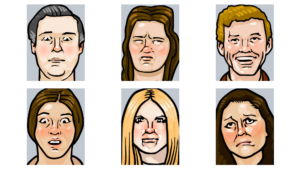
FACS identifies facial expressions by action units. An action unit (AU) corresponds to an observable effect on the face of an underlying muscular contraction. It is designated by a number (1 to 44) and scored for intensity on a five-point scale.
Actors study these methods in order to be able to make certain expressions while acting. But they have to become connected to the moment so that their face responds truthfully on its own. They are not pushing emotions or making a face. Nor are the expressions big acting choices, but often the result of a real internal response.
Some famous actors have commented on the importance of facial expressions. For example, Adam Driver said, “A camera can capture a thought before you even realise you’re having it.”
Viola Davisagreed: “The camera reads the truth, every thought. If you’re not really feeling something, the camera will expose that.”
During their training, actors carefully observe their natural signals and facial reactions and decide which to control, stop or let flow, depending on the role.
Novice actors often have to rewatch their performances to find out their “acting tics”, as Natalie Portman calls them. In other words, those things that an actor does unconsciously, which can be destructive and not suitable for a role. After watching herself act, Natalie noticed her eyebrows were “moving like caterpillars”. That’s why ever since she was aware of her eyebrows when performing, while keeping it natural and trying not to overfocus on them.
Body language
Body language is also a vital part of sustaining a believable character. The human mind is heavily intertwined with the physical body. The body shows whatever a person feels. Stance, gait, gestures – all of it can reflect a character’s status and state of being.

For example, a manager can stand taller with a straight back when talking to their employee. An employee, when scolded, can lower their stance and head, appearing vulnerable and guilty. In film, when introducing a character, the audience can usually immediately clock the archetype of a character just by their first impression of the actor standing in a certain way.
This matters outside of acting too. American body language expert Patricia Starkworks with celebrities specifically on how to present themselves as confident and how to communicate this – all using body language.
She says:“Whenever they go to a red carpet, they know they’ll be judged all night. So we talk about owning the space, definitely not fidgeting, as that is the easiest way to spot nervousness.”
Some actors use Laban Movement Analysis,developed from the theories of modern dance pioneer Rudolf Laban (1879–1958). This involves observing how people move in real life via different factors (body, effort, shape, space). Then they associate those patterns of movement coming from similar people in order to form a character. This observation skill is really important when learning how a character should move and fill the space around them.
There are plenty of other techniques that actors use daily in their work. The Stanislavski Method, for instance, is a technique developed by the Russian theatre practitioner Konstantin Stanislavski (1863–1938). It’s a psychologically driven approach that encourages the actors to perform realistically by using emotional memory and physical movement to embody their character.
Another example is the Meisner Technique, which was developed by the American theatre practitioner Sanford Meisner (1905–1997). In this case, the technique focuses on genuinely and spontaneously reacting to other actors’ actions rather than relying on emotional memory.
The amount of analysis that professional actors put into their script, scenes and characterisation is insane, though it often goes unrecognised by viewers. However, each and every technique used correctly and to its maximum is what makes a great actor who’s believable on screen or makes the audience truly engage with a play.

Edited by:

© 2026 The Oxford School for the Future

