




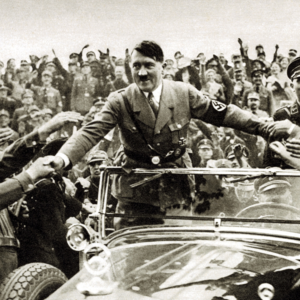
17-year-old Lola interviews historian Marcin Fronia about the legal failures behind Hitler’s political rise
Adolf Hitler became German chancellor in 1933, yet his rise to power began over a decade earlier.
After Germany’s defeat in the First World War, Kaiser Wilhelm the Second abdicated and the Weimar Republic was established. The new parliamentary democracy promised change.
However, its failure to reform key institutions helped pave the way for Hitler’s rise, says Polish-German historian Marcin Fronia in an exclusive interview with Harbingers’ Magazine.
Harbingers’ Weekly Brief
Subscribe to the Harbingers’ Weekly Brief, a newsletter written by the editorial board of Harbingers’ Magazine, the world’s youngest newsroom, delivered to your inbox every Monday morning.
![slide image]()
![author_bio]()


This republic was born amid political uncertainty. Under the Ebert-Groener pact, the military agreed to support the new government in exchange for keeping its internal autonomy and officer corps intact.
Despite the Weimar democracy being one of the most progressive of its time, it had an “old judicial mentality”. “Its foundation was flawed right from the beginning,” says Fronia.
The historian explains that German judges had been constitutionally protected and couldn’t simply be dismissed, which meant that even though most were “monarchists at heart” they were able to keep their jobs. In turn, Germany became a “republic without republicans”.
The failure to reform Germany’s legal system directly affected Hitler’s and the Nazi Party’s (NSDAP) rise to power.
View this post on Instagram
The Munich Putsch
On 8 November 1923, Hitler and 2,000 Nazi soldiers marched into the Munich Beer Hall declaring a “national revolution” in an effort to overthrow the Weimar Republic. However, the Munich Putsch was quickly crushed by the armed forces and local Bavarian police.
Hitler was arrested for treason and sentenced to five years in prison. He served just nine months, during which he wrote Mein Kampf (My Struggle), outlining the political ideas that later became the foundation of Nazism.
According to Fronia, Hitler’s short sentence was a direct product of the flawed justice system of the time. He explains that right-wing perpetrators of political violence often received light sentences, reinforcing the perception that “nationalist violence carried little risk”.
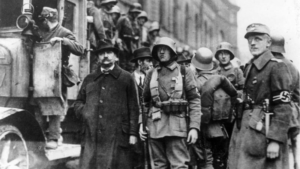
Under today’s German Criminal Code, the sentence for high treason – “undermining the continued existence of the Federal Republic of Germany” – is a minimum of ten years but can extend to to a life sentence.
Article 48 of the Weimar constitution allowed the president to rule by decree, making the technical democracy not only “biased and authoritarian” but “structurally fragile”, says Fronia. Moreover, Hitler never faced the full ramifications of his actions.
Hitler’s time in prison was far from tough, even described as a “holiday”. He had privileges that no other prisoners did. He had hundreds of visitors, bought a Mercedes and had plenty of beer despite describing himself as a “complete anti-alcoholic”.

Although Hitler was banned from public speaking until 1927, the restriction was unevenly enforced. Combined with the propaganda efforts of Joseph Goebbels and the Nazi newspaper Völkischer Beobachter, Hitler “never really stopped his political work”, says Fronia.
Historians continue to debate which factors were most important in Hitler’s rise to power. Economic crises, such as hyperinflation in 1923 and the Great Depression (1929–33), political instability and the weaknesses of the Weimar Republic all played a role. Fronia argues that the justice system was another key factor.
If the jury and civil servants had not been biased in favour of Hitler’s extreme right-wing politics and if he been given the lengthy imprisonment he deserved, who knows what would have followed. However, Fronia believes Hitler’s trial and imprisonment ultimately worked “enormously and almost entirely to his advantage”.
Proportional representation
The Weimar constitution democratised Germany’s leadership and, in an intention to be fair, eventually paved the way for Nazism. A key change invoked by the new constitution was the introduction of proportional representation.
This gave parties seats in parliament according to the share of votes they received. While this was the most egalitarian way of going about politics, it also allowed extremist parties such as the Nazis to gain more exposure.
After the Beer Hall Putsch, Hitler realised that violence would not bring him to power and turned to the Legalitätstaktik, or the strategy of legality.
Fronia describes it as an attempt to “win power through elections” while exploiting the constitutional system in order to “dismantle the system from within, once in office”.
Many modern democracies, including Germany, Poland, Sweden and New Zealand, still use proportional representation. Many include a 5% electoral threshold, making it harder for very small extremist parties to enter parliament.
However, creating an electoral threshold cannot always keep extremism out. Today in Germany, the far-right party AfD (Alternative for Germany) continues to grow. Key AfD members, including Björn Höcke, have repeatedly used language associated with the Nazi era, leading historians and political commentators to draw comparisons with aspects of Germany’s past.
While the rise of such politics today seems alarming, understanding the historical factors that contributed to the rise of Nazism can help people recognise dangerous extremism before it takes hold.

© 2026 The Oxford School for the Future

