



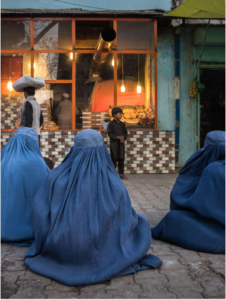
18-year-old Maryam from the Afghanistan Newsroom explains how morality is being used as an excuse to control women’s lives
Earlier this year, Taliban authorities in Takhar province in north-east Afghanistan issued a directive asking the Interior Ministry, including female police officers, to help deal with what they call “rebellious” women.
The directive, which some observers describe as administrative and neutral, is in fact a new step in the intensification of restrictive policies against women. This is not just an order relevant to a specific province; the words carry a larger and more serious message about the direction of power in Afghanistan today.
It comes amid a broader increase in arrests and harassment of women across Afghanistan, particularly over hijab enforcement, with reports of detentions in cities such as Herat and Kabul.
View this post on Instagram
After the Taliban returned to power in 2021, they quickly created ministries for public and social oversight. One of the most important of these institutions is the Ministry of Prayer and Guidance and the Promotion of Virtue and Prevention of Vice. Its official mission is to preserve and promote Islamic values, but in reality it has become a tool to restrict women’s clothing, education, work and social presence.
According to a recent UN report, the ministry is cracking down on and even imprisoning women who do not comply with dress codes or social behaviour. This represents a shift in moral oversight to the security level, meaning that what was previously called “moral misconduct” is now defined as a threat to social order.
This action is about control and surveillance before it is about morality or public order – the control of women’s voices, bodies, movements and even identities in the social space.
The use of the term (“rebellious women”) in the Takhar province order is not accidental. Rather, this term has a security connotation and shows disobedience as a threat. In this linguistic framework, women are not only not citizens with rights, but are also presented as a powerful destabilising element.
Such language has three clear messages:
- Securitisation of female identity: transforming differences in dress or behaviour into a security issue.
- Invalidation of protest: any disobedience, even peaceful, is defined as “rebellion”.
- Creation of public fear: when words take on a security connotation, the consequence can be arrest, prosecution or punishment.
Language is a precursor to action. When words become harsher, policies become harsher.
The Takhar directive also normalises the constant surveillance of women’s lives across the country. When morality and security forces are tasked with enforcing this surveillance, the line between the privacy of a country’s citizens and the ruling power is blurred.
There are wider implications to consider too. Self-censorship begins to expand because women limit their social presence to avoid danger. Women are gradually removed from the public sphere: from education to employment, each new restriction tightens the noose. And that creates a society accustomed to constant surveillance and ends up wearing out its resistance.
Harbingers’ Weekly Brief
Subscribe to the Harbingers’ Weekly Brief, a newsletter written by the editorial board of Harbingers’ Magazine, the world’s youngest newsroom, delivered to your inbox every Monday morning.
![author_bio]()
![author_bio]()


Control, not order
In such an environment, the issue is no longer just women’s rights; it is the future of the concept of citizenship in Afghanistan. Advocates of these policies may state that the goal is to “maintain public order” or “maintain Islamic values”. They say that every society has its own rules and that the government is obligated to enforce them.
But the fundamental question is whether order can be sustained by oppressing half the population. While the Taliban have managed to create a form of order through force, experts argue that this stability is brittle and rests on repression. Experience has shown that imposing silence does not mean consent.

When women are deprived of education, work and even freedom of movement, this is usually presented as a measure for maintaining order. But, in reality, these actions function more as a form of control than a way to promote stability.
What happened in Takhar province is not just an administrative order, it is a sign of a very deep trend towards criminalisingthe presence of women in society. Many women in Afghanistan have been forced to live in the shadow of restrictions that are increasingly visible in both their private and public lives.
This time, it requires serious attention from the global media, human rights institutions and the international community.
If women are rebellious today, they may be criminals tomorrow. Now is the time to be sensitive about words because words shape the future. Indifference leads to normalisation. And normalisation leads to consolidation.

Edited by:

© 2026 The Oxford School for the Future

