



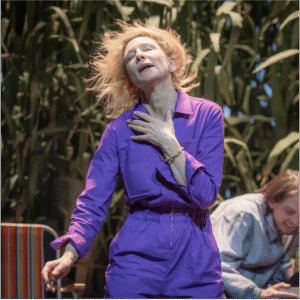

16-year-old Klara Hammudeh reviews Chekhov’s play The Seagull, on a limited run in London
Anton Chekhov’s 1896 play The Seagull takes place at a country estate by the lake – which is precisely what one sees when sitting at the Barbican Theatre in London. The audience is where the body of water would be, turning the stage edge into the shore, with the centre of the set (designed by Magda Willi) occupied by reeds from which actors emerge. Folding chairs add a relaxed atmosphere of a country retreat.
Harbingers’ Weekly Brief
Subscribe to the Harbingers’ Weekly Brief, a newsletter written by the editorial board of Harbingers’ Magazine, the world’s youngest newsroom, delivered to your inbox every Monday morning.
![slide image]()
![author_bio]()
![author_bio]()


The Seagull is one of Chekhov’s four classic plays (along with Uncle Vanya, Three Sisters and The Cherry Orchard) that explore psychology and relationships under duress – young and old fall in love, have affairs and family difficulties, and mostly struggle between obligations towards their close ones and their personal agendas.
Much has been changed for the play to fit the 21st century. For example, Semyon Medvedenko – portrayed by Zachary Hart – was originally a provincial teacher, as this used to be the lowest-ranking member of a society at an estate in Russia; here he shows up as Simon, a working-class labourer from England, with a guitar.
Yet, the London adaptation by Duncan Macmillan and Thomas Ostermeier proved that the human condition has not changed at all since The Seagull was written in tsarist Russia’s time.
The staging proved Chekhov’s play timeless, so it is not surprising that people flew to London from all over the world to see Irina (Cate Blanchett), Kostya (Kodi Smit-McPhee), Nina (Emma Corrin) and Trigorin (Tom Burke) – and that the show’s entire six-week run was completely sold out well in advance.
Undeniably most captivating is Cate Blanchett’s portrayal of Irina Arkadina – on the stage, she became a selfish, narcissistic actress who loved herself so much that nothing was left for her son, Kostya. Smit-McPhee’s performance as Kostya was phenomenal – it’s not an easy job to bring to life a character of a depressed son who attempts to become a writer, but is pulled down by his self-centred mother.
The central mother-and-son axis is completed by the relationship between Trigorin and Nina. Trigorin, a famous writer and Irina’s boyfriend, is known to be one of the most unfathomable characters written by Chekhov.

Tom Burke performed the part in a way that (deliberately) left more questions than answers. Did he really love Irina? Was he wise or not? Did his books have any literary worth, or did they merely appeal to a sentimental mass readership? He was a difficult character to portray, but Burke did a fantastic job.
While reading The Seagull before seeing this performance, I felt that Nina – a neighbour Kostya falls for, but who engages in an affair with the much older Trigorin – is one whom we would call “a pick me girl”.To be honest, I despised her for that. Emma Corrin, however, was outstanding, breathing life into a character who decides to leave it all behind and take a shot at becoming a famous actress.
It is worth underlining how the costumes, designed by Marg Horwell, made characters’ personalities instantly understandable – Blanchett’s Irina first appears in a bright purple jumpsuit, to change later into sparkly jeans and a white T-shirt with her own name emblazoned on it. In contrast, poor and depressed Masha (Tanya Reynolds) wears oversized, baggy black clothes, underscoring her acute self-consciousness and insecurity.
What lifted the weight off the three-hour performance were almost standup-like interactions with the audience. Not only did these keep the audience focused, but also allowed for a discussion between a 19th-century-written character and audience members from the modern world.
This brings us to the play’s central question: to what extent is theatre important? Is staging classics necessary? The answer was there, at the Barbican: Chekhov’s play hasn’t aged between 1896 and 2025, and still allows us to seek answers to the essential questions of life.

Edited by:

© 2026 The Oxford School for the Future