



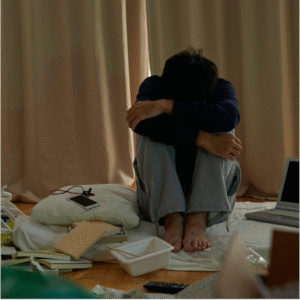
16-year-old Lola Kadas explores the phenomenon of hikikomori by unpacking its roots and recent rise
While social isolation may be present worldwide, there is a specific phenomenon in Japan called hikikomori, which means, according to the dictionary, “the extreme avoidance of social contact, especially by adolescent males”.
During a trip to Japan in the autumn of 2024, I gained deeper insight into this issue, which is deeply rooted in Japanese society. With hikikomori on the rise among Japanese youth – and becoming more common in other countries – it’s important to understand the causes, impact and context of this form of social withdrawal.
Harbingers’ Weekly Brief
Subscribe to the Harbingers’ Weekly Brief, a newsletter written by the editorial board of Harbingers’ Magazine, the world’s youngest newsroom, delivered to your inbox every Monday morning.
![author_bio]()


What is hikikomori?
Hikikomori is a psycho-social condition marked by severe social withdrawal, where individuals, primarily young people, isolate themselves at home and avoid all social interactions for six months or longer, sometimes years. They usually live with their parents, and don’t work or function independently. People who suffer from the condition are also called hikikomoris.
The term was coined in Japan in the late 1990s by psychiatrist Tamaki Saitō. It is now included in the Diagnostic and Statistical Manual of Mental Disorders (DSM-5), the internationally respected reference guide published by the American Psychiatric Association.
According to estimates from 2022, about 2% of Japan’s population – around 1.5 million people – are hikikomori. The phenomenon is most common among young male adults, but increasingly includes older individuals and women as well.
Hikikomori is most commonly associated with Japan, where the phenomenon is most deeply studied and most prevalent. But it is also increasingly recognised in other East Asian countries such as South Korea, China and Taiwan, where similar societal pressures such as academic competition, family expectations and stigma around mental health contribute to the problem.
In recent years, cases resembling hikikomori have also been reported in Western countries, including the United States,Italyand France,although the cultural context and underlying causes can differ.
What is the role of Japan’s culture?
Japan’s history plays a significant part in why hikikomori developed. During the Edo period (1603–1867), the Tokugawa shogunate, a kind of military dictatorship, cut off nearly all Western trade in Japan to avoid any influence it might have on the country. This meant that the country had to sustain itself for almost 300 years while being isolated from nearly the entire world, forcing it to become self-sufficient.
The term they used for this policy of inaccessibility was sakoku, which translates to “isolationism”. Interestingly, it was not only foreigners who were forbidden from entering Japan, but the shogunate also banned Japanese citizens from leaving the country – on penalty of death.
Both of Japan’s two main religions – Shinto and Buddhism – have their own views on isolation. Buddhism believes that activities that take place in isolation, such as religious study and meditation, can lead to self-discovery and reaching your fullest potential. In Shinto, however, isolation is not considered of particular importance.
In Japan, the pressure on men to be the breadwinners is very intense, often leading to high levels of stress and poor mental health.
Social norms associate masculinity with dedication to work, pushing many men to prioritise their jobs over their wellbeing.
The cultural expectation of self-sacrifice for the sake of the family is deeply rooted in Japan, and there is even a term for “death by overwork”: karoshi. This reflects a broader societal value that places work and responsibility above personal health, shaping the country’s social dynamics.
Tips for young people and parents
Supporting a hikikomori requires patience, empathy and care. These individuals often retreat from society due to deep emotional pain, fear of judgement or overwhelming pressure. Their isolation isn’t laziness or rebellion; it’s often a survival response.
To truly help, it’s crucial to recognise their suffering without judgement, approach them with empathy and openness, and avoid forcing them to “snap out of it”. Pushing them to return to school or social life too soon can increase their distress. Instead, focus on building trust, breaking rigid routines gently and supporting their wellbeing over achievement.
Avoid overprotectiveness, coercion (such as taking away internet access) or treating them as “sick”. These responses often backfire. Support should start with the family, especially parents, and should respect the hikikomori’s autonomy while encouraging small, meaningful steps forward.
The goal isn’t to force change but to be a steady, non-judgemental presence. Healing takes time and begins with understanding.

© 2026 The Oxford School for the Future