



15-year-old Arnav Maheshwari interviews Atlanta business owners about Trump’s economic policies
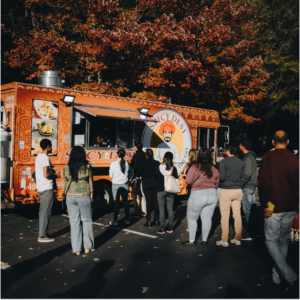
Rajath's Spicy Desi food truck in Atlanta.
7 February 2025
Trump 2.0: What small business owners expect from 2025
As Donald Trump returns to the White House, America’s 34 million small businesses are bracing for what comes next, with a mix of optimism and uncertainty.
Small businesses are the backbone of the American economy, representing 99.9% of all US businesses. They employ nearly 60 million workers and contribute 43.5% of the nation’s GDP.
These businesses are likely to experience significant changes and feel the ripple effects of new policies that could reshape local economies across the country and, ultimately, the macroeconomic trajectory of the US as a whole.
Many business owners are optimistic about renewed tax cuts, deregulation and a pro-business agenda under Trump’s administration. However, concerns over trade policies and rising labour expenses remain pressing challenges.
A key battleground state, Georgia played a momentous role in the 2024 election by narrowly swinging in Trump’s favour, who secured the state by a mere 115,100 votes. The state’s Metro Atlanta area, with over six million residents, is an economic powerhouse in the Deep South.
Harbingers’ Weekly Brief
Subscribe to the Harbingers’ Weekly Brief, a newsletter written by the editorial board of Harbingers’ Magazine, the world’s youngest newsroom, delivered to your inbox every Monday morning.
![author_bio]()
![author_bio]()


Harbingers’ Magazine interviewed small business owners in the Metro Atlanta region – focusing on service-oriented enterprises such as restaurants and car workshops – to understand their expectations for Trump’s second term and to explore the broader economic hopes and challenges within their local communities.
For Rajath, the owner of a food truck specialising in international fusion cuisine, the return of Trump offers both hope and caution. “If there are tax cuts, that is less money going out of my pocket and more that I can invest back into the business,” he explained, reflecting on how such an increase in financial leeway could allow him to expand and hire more staff.
“Maybe I could even think about getting another truck or increasing wages. Things like that would make a big difference for someone like me trying to keep things running smoothly and hassle-free,” he said.
But Rajath is also well aware of the risks that come with economic uncertainty. “The last four years under the Biden administration were especially hard because of corona [Covid-19] and inflation,” he added, recognising how inflation took a toll on consumer spending.
His business thrives when people have extra disposable income to spend on casual dining, and a shaky economy could undermine that. “If the economy starts strong, people will keep spending, and that’s good for food trucks. More people eating out means more customers for us,” he said.
The owner of a car wash and repair workshop (who asked to remain anonymous) sees Trump’s second term as a mixed bag, economically. While he welcomed the tax cuts made in Trump’s first term, the reality of rising costs outweigh those benefits.
“His tax cuts were nice at the time and gave a little breathing room. But, as we all know, inflation just keeps creeping up. You’d think tax cuts would make it easier, but prices are still rising on everything from auto parts to cleaning supplies,” he said.
His business depends heavily on consumers with imported cars, and remains vulnerable to international trade policies. He explained: “If we get more tariffs or problems with imports, cars and parts are going to get more expensive. All the cars we see here are Toyotas and other Japanese brands. If those get hit with higher tariffs, it’s going to make repairs more expensive for customers, which could affect how often they come in for servicing.”
Meanwhile, Marcos, who runs a Mexican restaurant, is more sceptical. “The tax cuts help the big places, but not the small places like my restaurant and or my son’s business,” he said, clearly frustrated.
The delicate balance between controlling costs and retaining customers was a constant challenge for Marcos during both past administrations – Trump’s and Biden’s. “We can’t just keep raising customer prices, especially when people tend to be careful with spending,” he noted. “For us, it felt like things were harder, not easier. The inflation has hit us hard, man.”
Marcos knows first-hand how higher costs impact both his bottom line and customers’ behaviour. “If people are struggling with their own money, they’re going to cut back on eating out. It’s just the reality,” he said, acknowledging the nature of consumer spending.
Ongoing inflationary pressures have forced him to make hard choices. “When prices increase, I need to increase the price of my food, and that means fewer people, less money.”
Trump 2.0: How will you be affected by Trumponomics?
Trump’s threat to impose heavy tariffs of 25%on imports from Mexico and Canada, has cast a shadow on North American trade. Mexicois the US’s largest trading partner (based on percentage of imports), with Canadain second place. China comes third. Together, these three countries account for more than 40% of all American international trade.
Despite being historically similar to NAFTA, the free trade agreement agreed by the US, Canada and Mexico and its renovated version, USMCA, this protectionist policy has caused rifts between the US and its two neighbours. Tariffs have the potential to disrupt industries dependent on cross-border supply chains, especially in the automotive manufacturing and agricultural sectors.
As Trump’s second term is now underway, small businesses feel a mix of hope and uncertainty: some see tax cuts as a welcome relief, while others fear the growing costs of tariffs, which will add further stress to industries reliant on imported goods. Over the coming months, it will become clear whether these policies will provide opportunities or deepen existing challenges.

Edited by:

© 2026 The Oxford School for the Future

