



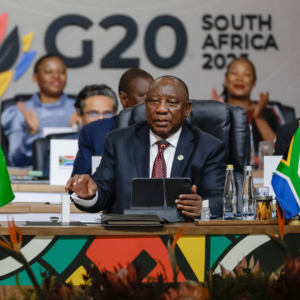
16-year-old Arnav explains the key economic and political takeaways from this year’s G20 Summit
The 2025 G20 Summit, held on 22–23 November in Johannesburg, South Africa, was more than another gathering of the world’s largest and most influential economies. For the first time, the G20 was hosted on African soil, a symbolic shift for a forum made up of 19 countries along with the African Union and the European Union. Together, they represent about two-thirds of the world’s population and roughly 85% of global GDP.
The absence of several major leaders, including US president Donald Trump, China’s president Xi Jinping and Russia’s president Vladimir Putin, added another layer to the moment. With the usual political heavyweights missing, the balance inside the room shifted, giving rooms for developing and middle-power economies – particularly those from Africa, South Asia and Latin America – a more visible role in shaping the agenda than in recent years.
Harbingers’ Weekly Brief
Subscribe to the Harbingers’ Weekly Brief, a newsletter written by the editorial board of Harbingers’ Magazine, the world’s youngest newsroom, delivered to your inbox every Monday morning.
![author_bio]()


Economic priorities
Economic pressures shaped much of the discussion in Johannesburg. Leaders noted that interest payments for low-income countries have more than doubled over the past decade, a shift that several leaders warn will divert essential spending on infrastructure, public services and economic resiliency.
Countries from Africa, South Asia and Latin America pressed hardest on these issues. Many pointed out that the cost of borrowing has risen sharply: average interest rates facing developing economies have climbed above 10% in 2024–25, compared with the low 3–4% available for advanced economies.
In several African states, interest payments have been taking a much larger share of government revenue, thus limiting what countries can spend on infrastructure, health or energy transition projects.
The G20 Summit also worked to focus attention on the need for financing and developing climate resilience, although the leaders didn’t pay special attention to environmental pressures. Leaders stressed the need for multilateral development banks to mobilise far more capital for energy transitions and disaster-risk reduction.
Additionally, South Africa framed these commitments with a more general focus on closing the financing gap – that being said, developing economies require more than $2.4tn annually in climate and development funding by 2030, yet only a fraction of that is currently being delivered.
View this post on Instagram
The Global South and Africa’s role
Hosting the summit gave South Africa room to shape the political tone, and it used that space to raise questions of representation inside global institutions. The African Union (AU) – which represents all 55 African states and is now a full G20 member – played a visible part throughout.
AU chair and Angolan president João Lourenço appeared alongside world leaders in the official photo, a symbolic moment that underscored Africa’s growing influence in core macro-level decision making.
The summit also revived older political alliances. India, Brazil and South Africa held their first IBSA leaders’ session since 2011, using the opportunity to align positions on multilateral reform and global governance. Their coordination signalled a renewed intention among democratic middle-income countries to work more deliberately towards pressing global issues concerning the Global South.
Other emerging economies carried that message forward. Indonesia’s vice-president Gibran Rakabuming Raka told leaders that “there is no single model that fits all”, arguing that cooperation should “empower, not dictate” and calling the meeting a “milestone” where the Global South is “no longer a bystander, but a co-driver of global progress”.
Brazil’s president Luiz Inácio Lula da Silva described the outcome as proof that “multilateralism will win”, praising South Africa’s presidency for creating genuine discourse at a time when major powers were absent.
Despite divisions, leaders still adopted a joint declaration – an outcome that seemed uncertain in the lead-up to the summit.
The declaration opened with a call for “solidarity, equality and sustainability”, language rarely seen in previous G20 statements and a reminder that, for all the tensions in the room, there is still political will to keep multilateral cooperation alive.
Still, the declaration did little to mask the fact that few structural compromises were reached – with no binding progress on debt restructuring timelines, no new capital commitments for climate finance, and no concrete reforms to IMF or World Bank governance.
Tension with the US
With President Trump absent and no senior US representative in attendance, tensions between Washington and Pretoria cast a shadow over the diplomatic sessions. Earlier in November, President Donald Trump announced that no US official would attend the meeting, claiming that South Africa’s “Black-led” government was persecuting the country’s white Afrikaner minority.

South African officials reject these accusations as unfounded, and they have been widely discredited.
President Cyril Ramaphosa saidit was “regrettable” that despite efforts to stabilise relations with Washington, Trump continued to apply punitive measures against South Africa “based on misinformation and distortions about our country”.
As the summit closed, attention shifted to next year’s meeting in the United States. US secretary of state Marco Rubio said the Miami-hosted event would mark “a new G20”, claimingthat South Africa’s presidency has “operated with spite and division” and confirming that Washington would not invite Pretoria to participate.
Instead, the US has invitedPoland to attend. This does not mean Poland is joining the G20, but it reflects Washington’s intention to broaden participation to countries it views as emerging economic partners.

© 2026 The Oxford School for the Future