


17-year-old Kexin put together the list of the year’s key words announced by dictionaries
At the end of every year, major dictionary publishers release their ‘word of the year’. Once just a quirky thing to do, it has turned into an annual tradition.
Although each organisation uses its own method to establish its chosen word – whether it’s data, popularity or voting – the choices ultimately all reflect something about the given year.
Here are the words of 2025.
Harbingers’ Weekly Brief
Subscribe to the Harbingers’ Weekly Brief, a newsletter written by the editorial board of Harbingers’ Magazine, the world’s youngest newsroom, delivered to your inbox every Monday morning.
![author_bio]()
![author_bio]()


Oxford Dictionary: ‘rage bait’
Oxford University Press named rage bait its word of the year.
Rage bait is defined as “online content deliberately designed to elicit anger or outrage by being frustrating, provocative, or offensive, typically posted in order to increase traffic to or engagement with a particular web page or social media content.”
Use of the word has tripled over the past 12 months, Oxford explained. It is also quite popular among Gen Z, and commonly used in everyday conversations. When someone is purposely irritating another person, that person may say: “You’re rage baiting me.”
This term was chosen through online voting that lasted three days, ultimately receiving more than 30,000 votes.
Two other words were shortlisted. One was aura farming – the cultivation of an impressive, attractive or charismatic persona by subtly conveying confidence, coolness or mystique. The other was biohack – to attempt to improve or optimise one’s physical or mental performance, health, longevity or well-being by altering one’s diet, exercise routine or lifestyle.
Cambridge Dictionary: ‘parasocial’
Cambridge’s 2025 pick – the adjective parasocial – is defined as “involving or relating to a connection that someone feels between themselves and a famous person they do not know, a character in a book, film or TV series, or an artificial intelligence”.

It is often used when talking about one-sided emotional relationships with influencers, celebrities, streamers or online personalities.
The term was coinedin 1956 by academics to describe a psychological relationship experienced by members of an audience in their mediated encounters with certain performers in the mass media, particularly on television. Now, the word has shifted into popular language and has been influenced by social media.
One example of fans using this term was when singer Taylor Swift and American footballer Travis Kelce announced their engagement.
Cambridge selected this word because of increased public interest and a spike in Google and Cambridge Dictionary searches.
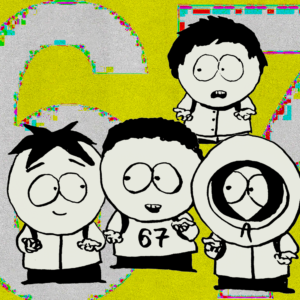
Dictionary.com: ‘67’
Dictionary.com picked 67 as the word of 2025, a choice that surprised many.
The number came from a song and emerged into a meme, where social media users started pairing the audio with sports footage. However, the phrase slowly migrated out of music and sport edits.
Several TikTok videos depict individuals in an In-N-Out (a US fast-food chain) yelling “six-seven” when the order number 67 was called. The ensuing disruption increased so much that the chain decided to remove the order number from its system.
@houseofhighlights Crowd went WILD. 😂👏 (@ ##67##meme##memes##funny ♬ original sound – House of Highlights
Teens and pre-teens began using 67 (pronounced “six-seven”) without any clear or consistent meaning, as a kind of inside joke – essentially a form of brain rotslang with no specific definition.
In meme culture, it can be used to mean “so-so”, to playfully interrupt conversations or to refer to anything with the number 67 in it. This choice highlights how even numbers can become cultural signifiers in the age of memes and social media slang.
Collins Dictionary: ‘vibe coding’
Collins Dictionary’s word of the year isn’t a slang phrase about mood or aesthetic. According to Collins’, the term vibe coding “captures something fundamental about our evolving relationship with technology”.
The term was coined in February by OpenAI co-founder Andrej Karpathy, who came up with the name to represent how AI can let some programmers “forget that the code even exists” and “give in to the vibes” while making a computer programme. In short, it means telling a machine what you want, and the AI writes a code for you.
Vibe coding was one of ten words on a shortlist alongside clanker, glaze (in the meaning of excessive flattery) and micro-retirements.

Edited by:

© 2026 The Oxford School for the Future