



18-year-old Noah rounds up his favourite articles from our seven newsrooms located around the world
My favourite part about being Editor-in-Chief of Harbingers’ Magazine has been working closely and forging relationships with writers from all over the world. This year, I was even able to visit the Nepali Newsroom team in person at the Mountain Children Home in Kathmandu, and meet members of our Sri Lankan Newsroom in Galle and Colombo.
We’ve had seven newsrooms operating in 2025, in many different places: Armenia, Afghanistan, Nepal, Sri Lanka, 2025 Poland (covering the presidential election), 2025 Japan (covering the 80th anniversary of the atomic bombing of Hiroshima and Nagasaki) and the new Film & Book Club (based in Warsaw, Poland).
Harbingers’ Weekly Brief
Subscribe to the Harbingers’ Weekly Brief, a newsletter written by the editorial board of Harbingers’ Magazine, the world’s youngest newsroom, delivered to your inbox every Monday morning.
![slide image]()
![author_bio]()


The work of our newsroom writers shows not only the strong voices of teens, but also sheds light on important worldly topics that may not be covered in the mainstream media.
I have chosen articles from each newsroom that have caught my attention in 2025 (listed in chronological order). So, get ready for a world tour!
Armenian Newsroom:
Alyona Sargsyan writes about Azerbaijan’s 2023 blockade of the Nagorno-Karabakh region, which created a severe humanitarian crisis. Alyona explains that pregnant women were among the hardest hit. She interviewed journalist and activist Tatevik Khachatryan, who co-founded The Center for Support of Mothers of Artsakh. Khachatryan explains how the organisation led protests, raised awareness and continued to help displaced families after they had fled to Armenia.
Sri Lankan Newsroom:
Abortion in Sri Lanka: a danger if you do and a danger if you don’t
Lisindi Liyanage writes about the dangers resulting from Sri Lanka’s restrictive abortion laws as well as poverty, social stigma and poor sex education. She also interviewed a maternity nurse to get first-hand testimony about unsafe and illegal abortions. The piece raises awareness of women’s health risks and calls for compassionate, informed reforms.
2025 Polish Newsroom:
Why the Polish right keeps winning: Exclusive interview with Andrzej Leder
Ten students from the Polish Newsroom collaborated on an exclusive interview with Andrzej Leder, a philosopher and professor at the Institute of Philosophy and Sociology of the Polish Academy of Sciences, to get an understanding as to why Poland’s right has been so successful. Male resentment amid changing gender roles, economic difficulties and Poland’s own history all play a part.
2025 Japan Newsroom:
Daniel Zhang, Elias Malmqvist, Jamie Chen, Katie Chan and Lukas Abromavicius worked together to interview individuals at the ceremony to commemorate the 80th anniversary of the bombing of Hiroshima, which killed 140,000 people. They describe the importance of survivor testimonies, as well as highlight the importance of peace and nuclear deterrence.
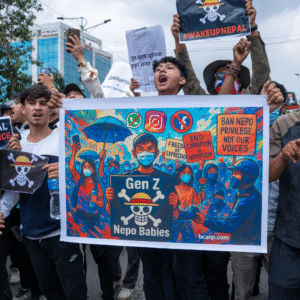
This trilogy of articles report on the youth-led demonstrations in Nepal in September that aimed to fight corruption and social media restrictions. Powered by grievances about inequality, unemployment and other political and social issues, the protests ultimately led to the fall of the unpopular government. They show the power of digital-age youth activism, and how young individuals can reshape politics to spark change.
Afghanistan Newsroom:
What I’ve learned from Afghan journalists who report in secret
Malaika explores how in modern-day Afghanistan, journalism students must learn under extreme repression. In spite of the political and social environment, journalists behind the scenes, many of them women, work to document realities that the Taliban seek to keep hidden. It is inspiring to read how the courage of these unseen heroes helps shed light on information that would otherwise be erased.
Barbara Dudzic and Zosia Karsznia interview casting director Klementyna Szymańska, exploring a process that is focused on authenticity and chemistry. Mentorship, risk-taking and support for actors are all important aspects of the job. Further, contrary to a common preconceived notion of a cut-throat film industry, Szymańska shows how relationships can be meaningful and centred around the growth of the actors.

© 2026 The Oxford School for the Future