



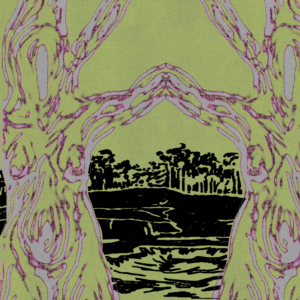
17-year-old Viola highlights the dangers of deforestation and what teens can do to combat it
Viola Papp is the one of the winners of the Harbinger Prize 2025. This is her winning entry.
Since the beginning of time, there has been one singular concept that all cultures have agreed upon. By using terms such as Terra Mater, Gaia and Mother Nature, they all unconsciously admitted the unbreakable bond between women and the Earth.
The unconditional nourishment that both provide creates a deep interconnectedness between them. No wonder that we can notice many parallels in the way that society has treated women and nature throughout history.
Harbingers’ Weekly Brief
Subscribe to the Harbingers’ Weekly Brief, a newsletter written by the editorial board of Harbingers’ Magazine, the world’s youngest newsroom, delivered to your inbox every Monday morning.
![image]()
![author_bio]()


Economies today value profit, domination and extraction over the well-being and harmony of all living creatures. In the eyes of society, the significance of supposedly feminine qualities such as gentleness, caring and nurturing started to decline.
This has led to the dominance that was imposed on both women and nature, resulting in many societal and environmental issues. The exploitation of women and the Earth created the false narrative that both can be owned by men and can function as property. This conveniently forgets the fact that when we’re undermining the value of the ones who created us and constantly nurture us, we mark the beginning of a war against life.
The birth of ecofeminism
In 1974, French feminist writer and activist Françoise d’Eaubonne, introduced the theory of ecofeminism, which she described as a multifaceted movement that recognises the link between gender and ecological issues.
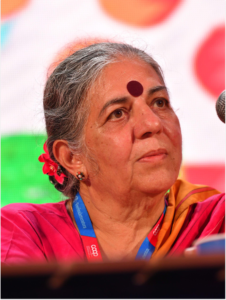
Indian environmental activist Vandana Shiva, 2022.
In her book Féminisme ou la Mort she acknowledged that both environmental problems and gender inequality can be traced back to the same root: suppression by a male-dominated society. With this unconventional perspective she inspired women to look at feminism through a transformative lens and to advocate for a future where humanity and nature can coexist in harmony.
One of the many women whose work was heavily influenced by ecofeminist movements is Indian environmental activist Vandana Shiva. Her activism journey started in the 1970s with the Chipko movement in rural India, where women gathered to hug and embrace trees in their local forest to prevent them from being cut down. The Hindi word chipko means ‘to hug’ or ‘to cling to’.
Since then, she has founded organisations to protect people’s rights and biodiversity, and published books discussing important topics such as sustainable agriculture and social justice. Inspired by the women of Chipko, she also created Navdanya, a women-centric movement led by farmers to protect indigenous seeds in India.
For her accomplishments, Shiva has won numerous awards such as the Sydney Peace Prize and been recognised as an ‘Environmental Hero’ by TIME Magazine. Vandana Shiva’s life story may remind everyone that not all heroes wear capes; some of them walk around in saris and advocate for a more sustainable future by protecting the Earth and sharing their wisdom.
Alongside her remarkable knowledge, her actions and endurance also set a notable example for the next generation. Especially the Chipko movement, which marked a revolutionary change in the history of environmental activism, paving the way for non-violent forms of resistance against deforestation.
Although decades have passed since the Chipko movement, the importance of forest conservation movements has – unfortunately – not decreased. In fact, it has skyrocketed in recent years. Despite international efforts towards preventing large-scale deforestation, it remains one of the most vital environmental issues of today.
Policy changes including the 2015 Paris Agreement, the 2023 EU Deforestation Regulation and the annual UN Climate Change Conference – the latest, COP30, concluded a few weeks ago – have been implemented globally in order to protect the forests. Nevertheless, we still continue to lose forests at a rate equivalent to 27 soccer fields a minute, which adds up to 10 million hectares lost every year.
Dangers of deforestation

Deforestation causes harm in many arenas, including biodiversity, social justice and public health. As Vandana Shiva says,biodiversity is “the teacher of abundance and freedom, of cooperation and mutual giving”. By neglecting biodiversity, we disparage the value of uniqueness and creativity.
Since forestshold 80% of terrestrial biodiversity, countless species are disappearing at an alarming rate. Animals under severe threat include koalas, mountain gorillas and orangutans as well as countless insect species.
In addition, Indigenous communities are also in serious danger due to deforestation. Some 80 millionpeople – equivalent to the population of Turkey– are dependent on forests for their livelihoods.
Mass deforestation can also be the cause of countless major public health issues. As wild animal populations are gradually losing their natural habitat, their contact with humans increases, which gives animal-origin germs – zoonotic pathogens–a better opportunity to spread. This enhances the outbreak of zoonotic diseases such as malariaand worldwide pandemics.
And this is only one issue – extensive deforestation contributes to even more public health problems through air pollution. High exposure to pollutants such as particulate matter, carbon monoxide and nitrogen dioxide results primarily in lung, heart and brain diseases including strokes and cancer. Forests play a prominent role in decreasing these pollutants in the air, so by cutting them down we become our own victims in the global health crisis.
Moreover, air pollution heavily exacerbates climate change by strengthening the greenhouse effect.
At the same time that we are turning our forests full of life into a lifeless and barren wasteland, we are also worsening our climate.
As demonstrated, forests are essential when it comes to the well-being of our society and our planet. Besides providing us nourishment, they also shield us from environmental disasters including wildfires and floods.
Furthermore, all ecosystems rely on them, as they’ve been the lungs of our planet since the beginning of life and provided us with the conditions for living ever since.
What you can do
It’s our responsibility to stand up for trees and to protect them as much as we can. One way to do this is by making conscious choices about our consumption behaviour. For instance, look for labels such as FSC (Forest Stewardship Council) or RSPO (Roundtable on Sustainable Palm Oil), which help to support sustainable businesses. Innovative digital solutions that combine efficiency with climate action – such as the Forest app or the search engine Ecosia – also exist.
If you want to make a change without technology, you always have the option to go outside and plant a seed. You can also have a huge impact by donating to charities, volunteering or joining organisations that aim to prevent deforestation such as WWF (World Wildlife Fund).
Something that we as teenagers can all do, regardless of our time and financial situation, is to raise awareness about the harmful effects of deforestation. Whether you’re speaking up among family and friends, taking part in a protest, or posting about it on social media, you should know that your voice matters.
As Dechen Tsering from the United Nations Environment Programme (UNEP) in Asia Pacific says about young activists: “Your involvement in shaping the global environment and economic agenda is brave, and the world is listening. Please keep voicing your concerns and calling for real action.”
All that happens in the future is in our hands. We decide whether we keep walking on a path surrounded by barren wasteland or take action and plant the seed. It’s our responsibility to fight on the right side in the war against life.

© 2026 The Oxford School for the Future