



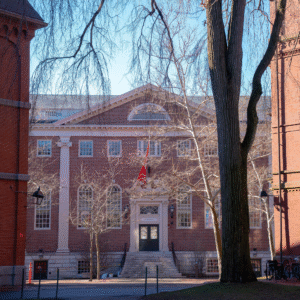
16-year-old Arnav investigates the Ivy League’s relevance amid rising debt and a changing job market
Degree. Career. Stability. That was the formula for generations in the United States. In theory, a college degree brought a stable job, a suburban house with a white picket fence, a green lawn and perhaps a German sports car in the driveway. It was the promise of upward mobility – the gold standard of the American Dream – and at the top of that dream, stood the Ivy League.
A group of eight elite private universities in the northeastern US – Brown, Columbia, Cornell, Dartmouth, Harvard, Princeton, the University of Pennsylvania and Yale – the Ivy League has long been seen as the pinnacle of academic and athletic excellence in the world. With single-digit acceptance rates, each school is known for its own strengths, from Harvard’s leadership in law and business to Cornell’s engineering programmes and Brown’s open curriculum.
Harbingers’ Weekly Brief
Subscribe to the Harbingers’ Weekly Brief, a newsletter written by the editorial board of Harbingers’ Magazine, the world’s youngest newsroom, delivered to your inbox every Monday morning.
![author_bio]()
![author_bio]()


However, Ivy League tuition has surpassed $90,000 per year, while the average public university costs less than $30,000. The result: US student debt has crossed $1.8tn, and the average graduate now leaves school with roughly $39,000 in loans. Going to college, once viewed as the safest investment in America, now carries financial risk that nearly rivals the stock market.
So, is it still worth it?
Harbingers’ Magazine spoke with college students from across the US – from Ivy League campuses to public universities and community colleges – to understand how Gen Z is navigating the value of higher education in 2025.
Ambition at a cost
Akshat Pandey was accepted at several private universities, but chose to go to a public university and to stay in his home state of Georgia to avoid paying higher tuition fees in another state. As a pre-law and finance major, he already has his sights set on law school.
“I didn’t apply to too many out-of-state schools,” he said. “Prestige mattered too, but I was really thinking about what would give me the best return on investment as an undergraduate, especially since law school is going to be expensive.”
Akshat’s mindset reflects a growing realism among Gen Z students who are looking years ahead. For him, the undergraduate degree is not the finish line, but the foundation for what comes next. “I wanted to go somewhere that would give me good resources and a bit of distinction among my peers,” he said, “but without paying too much now.”
A few hundred miles north in New York City, a male student (who asked to remain anonymous) at Bronx Community College made a similar calculation. “I didn’t want to end up in debt before I even figured out what I wanted to do,” he said. “Bronx gives me a chance to breathe.” His goal is simple: learn, save and move forward on his own terms.
Even within the Ivy League, the equation looks similar, only the numbers are bigger. “Getting in felt like proof that everything I’d worked for finally meant something,” said Sadie Menard, a Brown University economics major from Kansas City.
“But once you’re here,” she said, “you realise how much it costs to live this life. Sometimes I think about how much cheaper it would have been to stay in Kansas, but I’ve also grown in ways I wouldn’t have anywhere else.”
Together, their stories hint at a shift in how college fits into life – less about chasing an ideal and more about finding what makes sense now.
Balancing prestige and purpose
At Columbia University, Ciarán Walsh described reputation as something that both opens doors and narrows them. Growing up between Ireland and the US, he saw Columbia as a bridge between those worlds. “The name carries weight,” he said. “Everyone’s chasing something remarkable, and it can feel like you’re just trying to keep up,” he admitted.
Sadie sees the experience differently. “I think the value of college now is more about how it shapes you as a person and gives you time to figure out what you actually care about,” she said. “Everyone’s so driven, and it’s easy to get caught up in what everyone else is chasing. But after a while, you realise not everything has to be a competition,” she said.
“I used to think success was about getting somewhere big. Now it’s about making my own choices and doing something that matters. Ivy or no Ivy – college gives you that space if you know how to use it.”
Numbers behind the dream
Studies show that early-career Ivy graduates earn about $86,000 a year, versus $59,000 for non-Ivy grads. By mid-career, that gap grows to $60,000. This is known as the college wage premium.
However, economists note that the advantage is narrowing as tuition and living costs outpace wage growth, given that it now takes many graduates more than two decades to fully repay student loans.
“If the college wage premium is basically flat over a period when the cost of college is going up, that reduces the typical financial return to a college education,” said Federal Reserve economist Robert Valletta. His point reflects a broader shift in how college is being evaluated.
In fact, while the average return on a bachelor’s degree remains positive at around 12%, it has barely grown in a decade – evidence that the payoff is stabilising even as costs rise.
Changing job market
For students like Akshat, the shift feels obvious. “College still matters,” he said, “but what you do during college matters more. It’s not enough to just graduate – you need skills, experiences and connections.” The Bronx Community College student put it more bluntly: “The job market cares about what you can do, not what you say you’ve studied.”
Ciarán sees the same trend. “AI is changing the kinds of skills that matter,” he said. “A degree is still useful, but it’s no longer the full picture.”
As AI transforms the job market, higher education is racing to keep up. Companies such as Google, Apple and IBM have dropped degree requirements for an increasing number of roles, signalling that “soft skills” often outweighs pedigree. Research shows that fewer young adults today see a four-year degree as essential for success than they did 20 years ago, a reflection of how education is being redefined by technology, cost and opportunity.
The Ivy League still holds its prestige, but it’s no longer the only light guiding the way forward. The dream hasn’t disappeared; it’s just been redefined. The path that once led straight from degree to a career now winds through questions of cost, meaning, and return.
Microcredentials, online certifications and skill-based programmes are beginning to stand alongside four-year degrees as equally valid routes into the workforce. As employers look for adaptability and creative problem-solving, students are building value in ways that classrooms alone can’t teach.
“The goal,” Ciarán said, “is staying curious and adaptable while trying to build something that matters.” For a generation facing rising costs and rapid change, that curiosity might be the most valuable degree of all.

Edited by:

© 2026 The Oxford School for the Future